Lyskamm – North Face
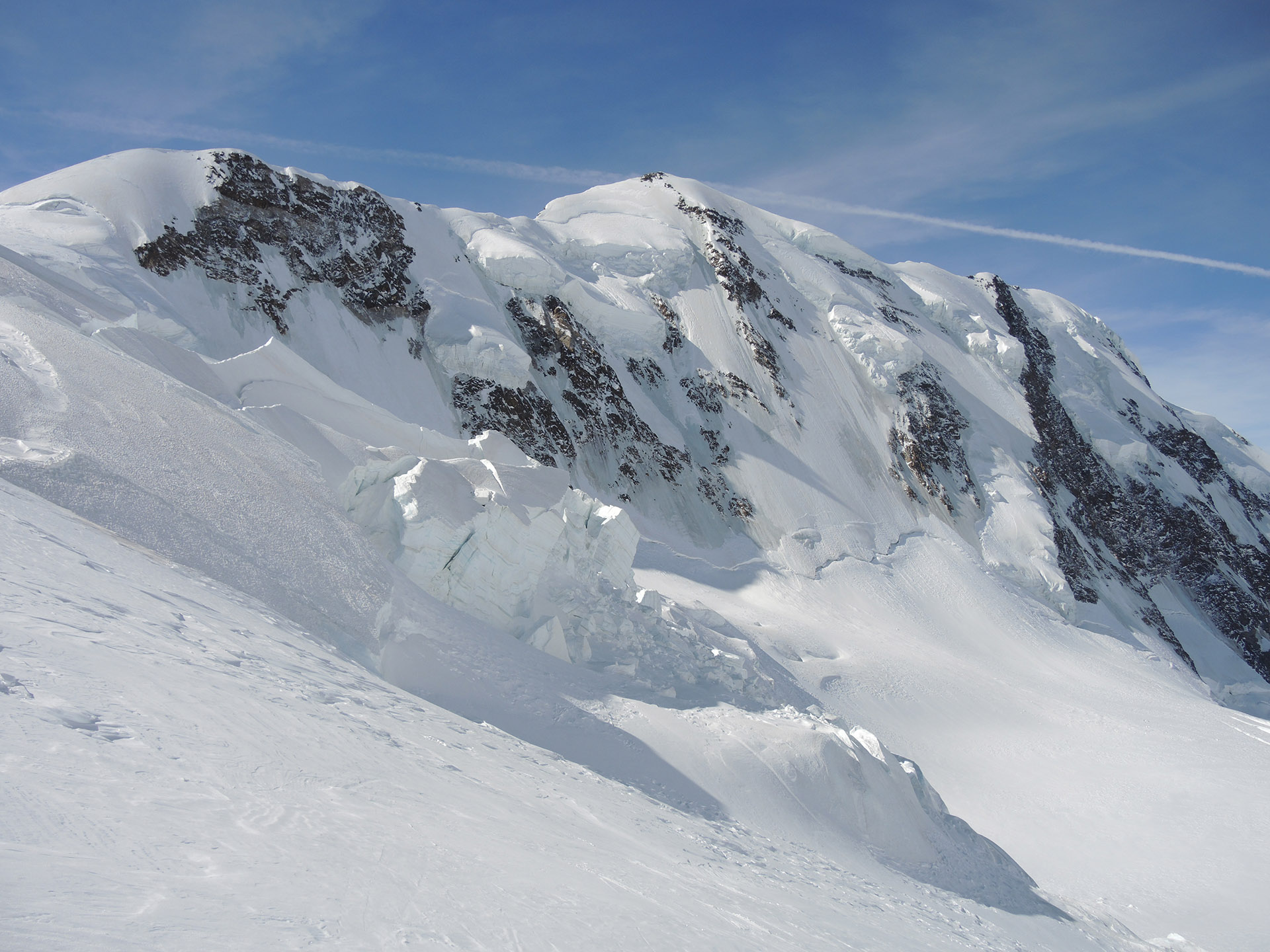
A wall of snow and ice that stretches nearly 1,000 metres upwards. The North Face of the Lyskamm is possibly the most famous north face climb in the Alps.
Lyskamm forms part of the Monte Rosa group in the Pennine Alps that runs along the Swiss-Italian border between the Canton of Valais and Aosta Valley. The Lyskamm actually has two distinct peaks, Western (4,481 m) and Eastern (4,527 m), joined by one of the most beautiful ridges in the entire Alpine region. The north face of the Eastern Lyskamm offers one of the most prestigious climbs in the Alps. It was first conquered by Ludwig Normann-Neruda in 1890. The route currently favoured, which is entirely over snow and ice, was first used in 1925 for the fourth north-face ascent.
We believe that adventure is the soul of life. Our mission is to inspire people to be able to overcome their limits. Such as the spirit created between rope partners, we believe in the value of sharing experiences and emotions
We believe that adventure is the soul of life. Our mission is to inspire people to be able to overcome their limits.
Such as the spirit created between rope partners, we believe in the value of sharing experiences and emotions
Difference in altitude: 380 m
Ascent time: 2 hours
Meeting point: Staffal (Gressoney La Trinité, AO) at 2:00 pm for equipment check and a short briefing with the Guide
We take the cable car up to Punta Indren (3,270 m). From there, we proceed on foot either to the Mantova Hut (3,498 m), about an hour’s walk, or directly to the Gnifetti hut (3,647 m), a walk of about two hours. Dinner and overnight stay at the hut.
Difference in altitude: 1,200 m
Ascent/descent time: 8-12 hours
We set off from the hut at around 3.00 am. A relatively easy glacier walk then takes us to the Lysjoch (4,151 m). From there, we make a sweeping descent of the Grenzgletscher, until we can pick out the correct climbing line. Having found the easiest point to cross the bergschrund, we go up the mountain face, climbing at a constant 50°-55° gradient until we are underneath the peak of the Eastern Lyskamm. This is a tough climb; the descent from the east ridge is technically demanding, with sheer drops, so a keen eye and a sure foot are vital.